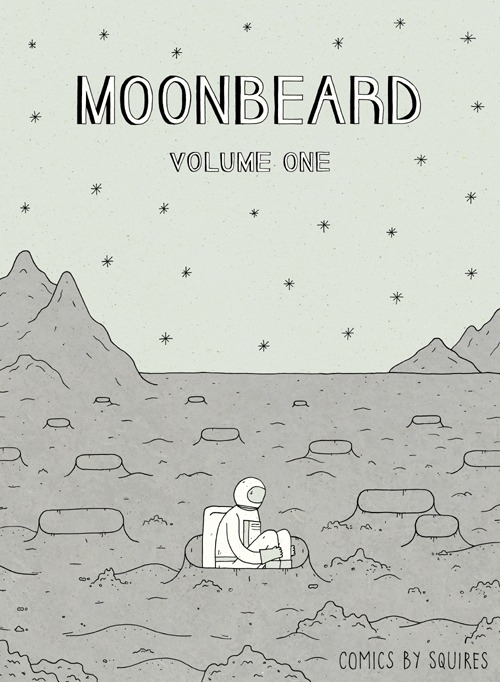
Moonbeard Volume One collects 132 pages of Squires' extremely popular and terrifyingly hilarious comics, Available at the Armageddon Popular Fun Convention in Auckland this weekend. Free Shipping with preorders available now from Te Pikitia Store. Preorders ship 1st Nov.
Word Balloons: Rosa Goes For a Walk and Good Dog Whisky
Australasian comic reviews by Philip Bentley.
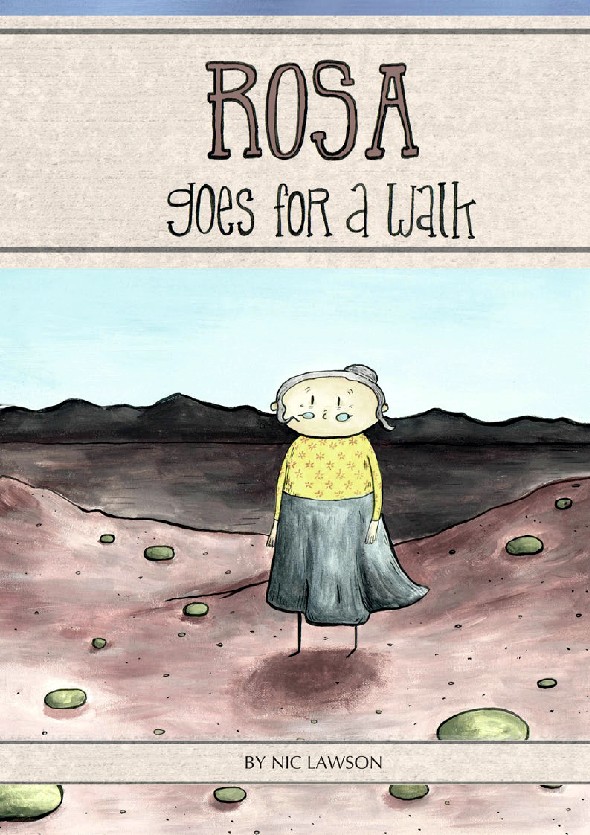
Rosa Goes for a Walk by Nic Lawson (self-published, 2013)
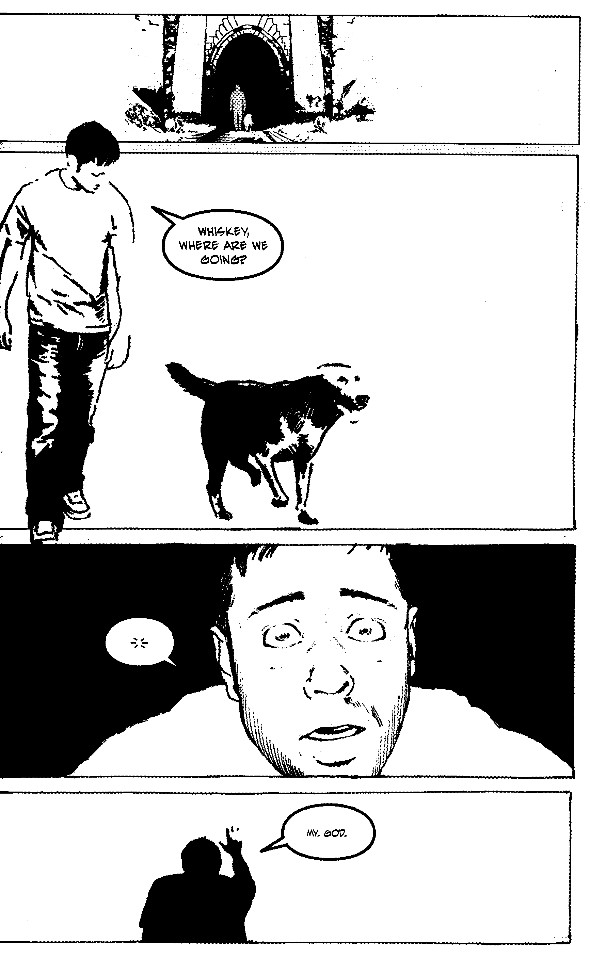
Good Dog Whiskey by Kent Kobi (self-published, 2013)
Comics about the notion of dying are not that common – as opposed to comics featuring death which are fairly thick on the ground. I guess this is because most comic creators are in the full flush of their lives and haven’t had reason to contemplate mortality beyond its use as a plot device. Whilst neither of the authors of the above two works appear to be more than middle-aged both have produced considered, moving works on the process of dying.

Nicole (Nic) Lawson’s Rosa Goes for a Walk is a whimsical, yet thoughtful narrative concerning an old lady living alone in an outback ghost town. Her daily routine is pretty similar until one day she espies a mound on the horizon that wasn’t there previously. Recalling her past life as an adventurer Rosa decides to ‘go for a walk’ into the bush to investigate.
More a parable than drama this is a largely wordless piece illustrated in a simple, yet effective cartoony style. It is a novel take on mortality and cleverly approaches it from a pan-spiritual perspective.
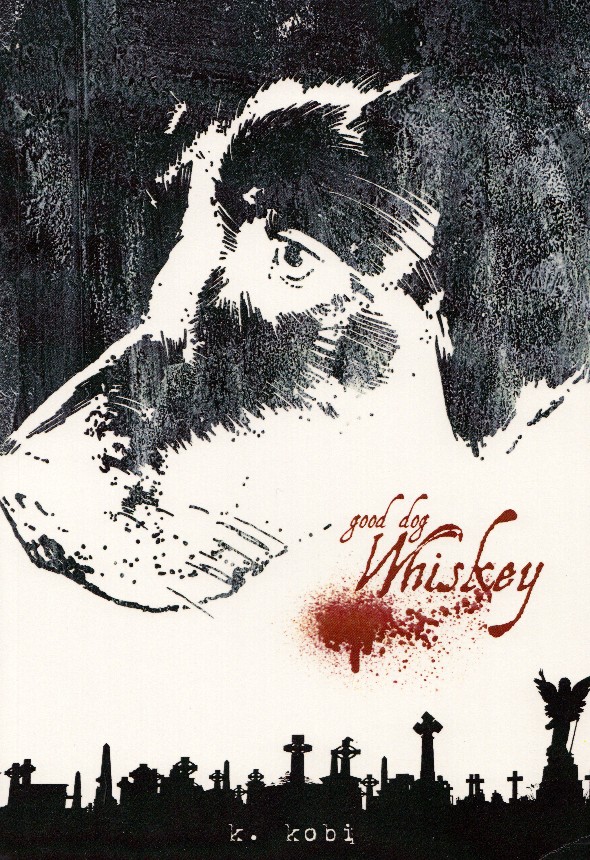
This is a difference between Rosa and Kent Kobi’s Good Dog Whiskey where the afterlife depicted has more of a standard Christian dimension, even if nothing is overtly stated. Whiskey also explores the process of dying, but beyond this is also an evocation of the deep bonds that some people have for their dogs, or in this case vice versa. Kobi manages to pluck the heartstrings in a sincere and moving fashion. Sensitive readers are advised to have a box of tissues handy.
My only beef with Whiskey, and it is a major one, concerns the artwork which appears largely to be made up of rendered photos. The use of this effect is not new (artists such as Jean-Claude Claeys and Fernando Fernandez were utilising similar methods as far back as the 1970s, probably using a light box or overhead projector), but its use has become more prevalent recently with the availability of Photoshop. I don’t want to be too hard – if the choice is between rendered photos or inferior art then the former is certainly preferable – but ideally I’d prefer to see fully drawn works where the element of craft is more to do with the artist’s drawing ability than his computer expertise. Using this process inevitably means that you produce fairly static images, whereas part of the alchemy of the figurative drawing process (both in comics and single illustrations) is to produce figures that have the illusion of movement. Further, there is often a disjuncture between the images that have been rendered from photos and those that haven’t leading to an inconsistent look to the work. Thankfully in this case the story does lend itself to the process, as there is no need for expansive backgrounds, but for me it diminished what was otherwise a commendable effort.
For info on submitting comics for review read here:
Thrust Justice Preview (Warning Powerful Manly Images)
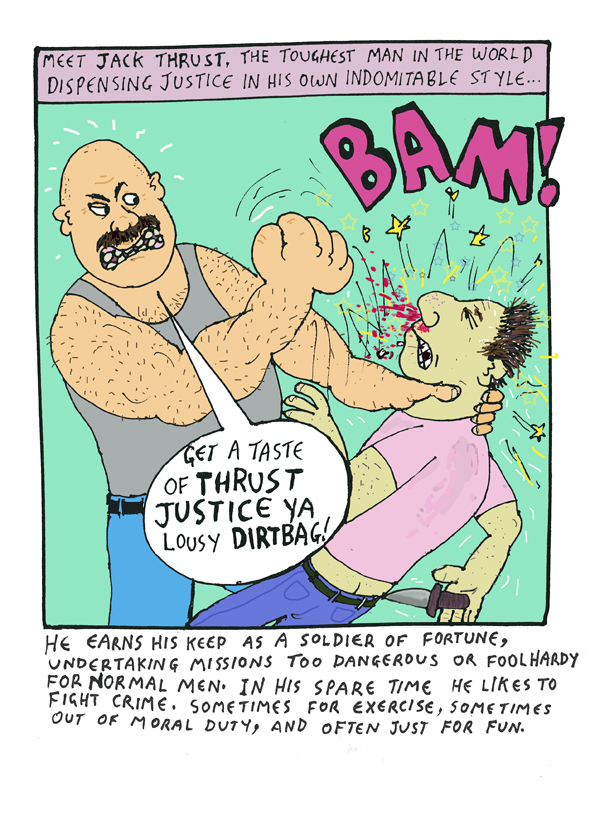

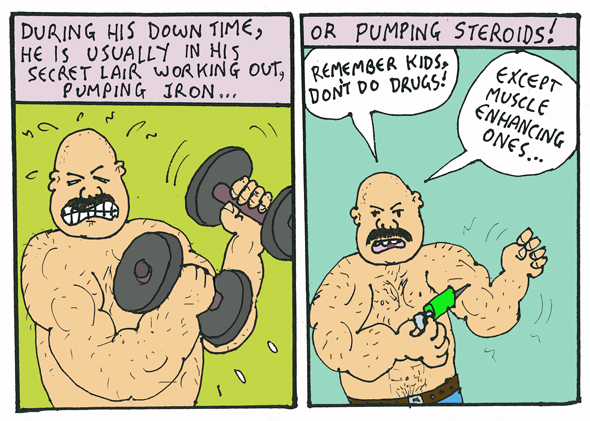
Here at Pikitia Press we like to publish manly comics about manly men, by manly men, for manly men. THRUST JUSTICE is one of those comics. New Zealand's hardest working cartoonist Brent Willis (tied with Barry Linton & Richard Fairgray) has produced a powerful work of literature that we are confident will win awards and get good reviews and all the other special things one needs to enrich one's soul. Powerful with a capital THRUST.
Happy 48th Birthday Dylan Horrocks
Moira Bertram Article by Sally McInerney
The following Moira Bertram article written by Sally McInerney was originally printed in The Sydney Morning Herald, 6th August 1983.
Recently Sally shared her recollections of interviewing Moira,
"I was told about her by a friend of mine, who said that there was an eccentric comic-book artist living alone at … Mosman? Balmoral? And that it was a bit of a sad situation, because sheets of paper with her drawings on them were blowing out of a garbage bin at her house and along the street (my friend had seen them), and that she had once been very successful and was now alone and rather reclusive and even, perhaps, cranky. "
"I suggested to my editor that she might be a good person to interview, and so went to see her, accompanied by the photographer Gerrit Fokkema, who was also working at the SMH at that time. There was something gloomy and shadowy about the house, which was probably mostly Moira’s mood. We felt rather sorry for her. Gerrit took a portrait photograph of her which was published with my article. Moira then promptly contacted the SMH and complained that the standard newspaper byline, “photograph by Gerrit Fokkema”, was a barefaced attempt to claim authorship of a framed picture (a painting?) slightly out of focus on the wall behind her, it was just part of the decor as far as we were concerned. I talked to her on the phone and managed to assure her that such a rip-off was nowhere in our minds, etc. So I concluded at the time that she was a rather troubled, difficult, unhappy, suspicious soul, who’d had a hard life. I hope that was not correct."
Moira, Flameman and Black Knox by Sally McInerney
People can be very surprising. If only you had the chance to find out, the man in workman's overalls at the bus stop might turn out to be the world's finest jazz pianist, the man in the grey-flannel suit might be a murderer, the fragile-looking woman buying food for her cat might have produced hundreds of flamboyant comic books, keenly chased by collectors all over the world. A friend from a publisher's office had mentioned a woman who'd telephoned to suggest that her comics might be republished in a book. The publishing house wasn't interested, but the woman seemed picturesque; otherwise, no one knew anything about her. I've always liked comics, so I arranged to call on Moira Bertram — that was the woman's name, of course. The small living room of her unit — in an "older-style" block — was clearly a work room. There was a sofa with velvet cushions, spare cushions for art students, a table with a small typewriter, a plaster bust, a pencil study of Michelangelo's David, a framed letter from one of the Queen's spokesmen declining the kind offer of a portrait, a very low coffee table covered with red leopard skin-patterned paper (on which were some albums), a small mirrored cupboard with glasses and a decanter on it.

From the picture rail hung several different drapes, dark and light. On top of the picture rail were two carefully lettered signs announcing Moira and Kathleen Bertram's art studio. To one side stood an easel holding a covered, part-finished portrait. Oil paintings lined the walls at a level higher than usual: a jungle scene, for instance, with a naked white girl (prostrate) and a handsome native, while lyrebirds and lightning lent drama to the background. No books, not even reference books, were in sight. An orange plastic bead curtain hung partly across the tiny bay window, through which launches could be seen at anchor on the real bay. Low on the wall under a spot light was a freshly-painted portrait of a beautiful young woman, smiling serenely out of the picture. "That's my sister," said Moira Bertram. "Her name is Kathleen. She and I have always worked together; I did the drawing and made up the words, Kathleen did the lettering — a wonderful partnership." There was a photograph of the artistic sisters in the room, too, taken quite recently. Moira Bertram was wearing trim corduroy jeans, a T-shirt and pink lipstick; she has pale blonde hair and is slightly built. Her manner is diffident and girlish, almost fey.
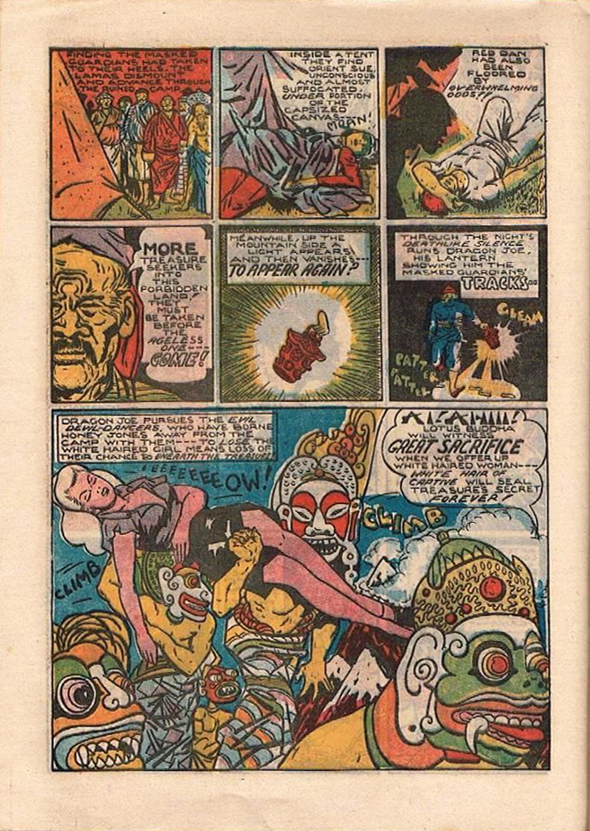
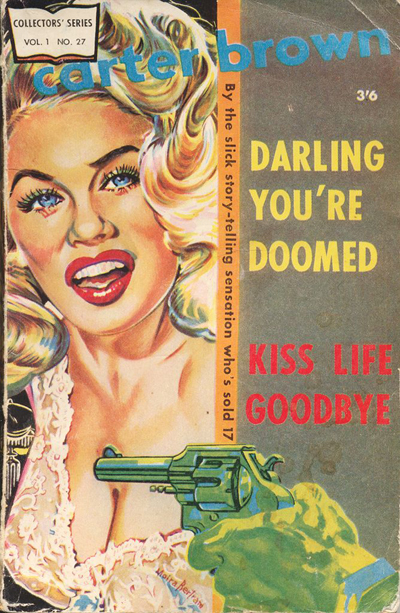
Rather shyly she produced dozens of old comic books, all her own work, and strew them across the table — black and white, coloured, war comics, a few love comics, and mainly adventure and science-fiction dramas. Many were 30 or 40 years old. "I always wrote the stories myself," she said. "Except for a few Carter Brown covers, I've never illustrated anyone else's work. I don't have a preference for a particular subject, I'm happy doing anything. I generally just made the story up as I went along." (A couple of Carter Browns with her covers were Madam, You're Mayhem! and Larceny was Lovely.) She picked up The Great Adventures of Dan Eagle (Number 3, nine pence). "Relentless heat ... savage natives ... and a daring airman who helps a Burmese police patrol rescue a white hunter," the cover promised. "This is pretty rough going, this stuff," said Moira. "because the printer's always waiting on it — 36 pages and the cover every month. I've done it all my life, but I said to my sister, 'I'll have to drop this for a while, it's too constant'; so I began doing portrait work — that was seven or nine years ago — but I think I'll go back to the comics. I've already started another one."
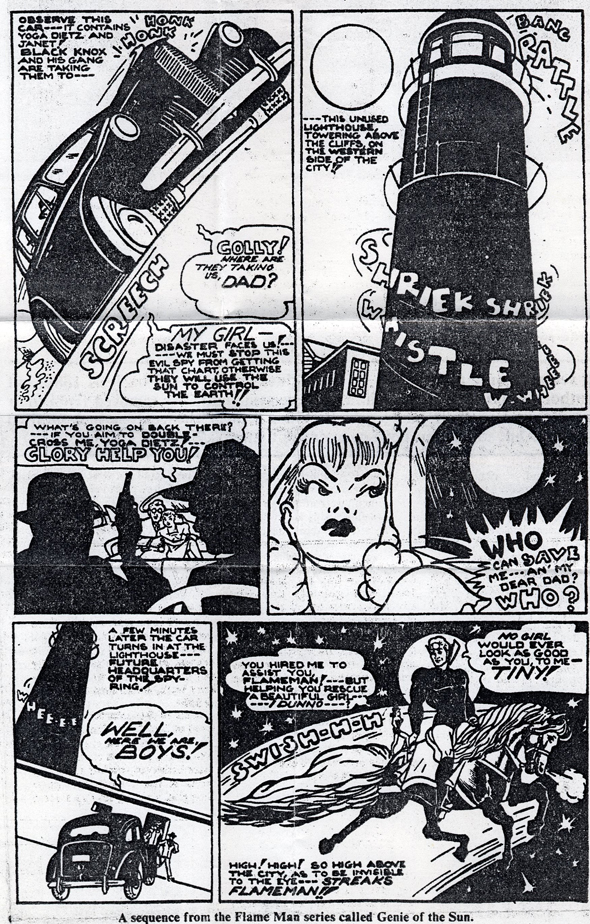
There were several issues of Flameman, Genie of the Sun, on the table too — a Climax Comic, six pence. Flameman's assistant, Tiny, is a voluptuous but good woman "no bigger than his middle finger", and these two are powerful allies against evil. ("I could clean you guys off the face of the earth with a whiff of radar, only it's not Flameman's code to kill," the hero says.) One of their opponents in this particular issue is Black Knox, a wicked international spy, who (seizing the heroine, Janet) snarls "'So you're the Yoga's daughter? CHARMING ... ' Black Knox is not blind to beauty — but never lets it hinder him!!!" Later, some roughneck baddies approach the villain's lair: "En route to the city, they enter the dense flame mountains ... where Satornit and his gang have their headquarters!" and one of the baddies remarks intelligently, "That's a creepy lookin' hangout!" Another Climax Comic of similar vintage showed a huge muscle man with pink face and black torso knocking out a big green African, who sprawled (stone cold) at the foot of the front cover. Elsewhere, rugged-faced men in work clothes leant against foreign lamp posts, lighting cigarettes behind cupped hands, and men in suits K.O'd others similarly attired. The drawings were completely professional, full of life.
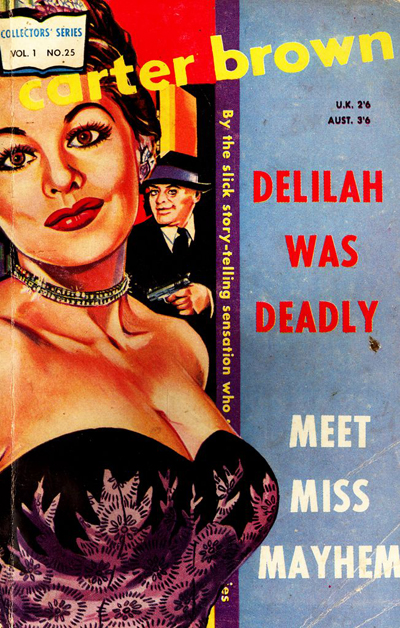
All this amounted to an unlikely occupation for a gentle-seeming woman like Moira Bertram. She had begun drawing and writing comics in about 1945, she said, when she was still at school (in this case, SCEGGS). She was learning portrait painting from Dattillo Rubbo at the time. "I don't know why I got started on comics really," she said. "I wanted to do them from the moment I first saw them. There's just something fascinating about them." So, when she was 14, she wrote a synopsis and drew a couple of pages of a tale called Jo and Her Magic Cape, took them to a publisher in Pitt Street, and waited . nervously while he looked at them. He said nothing at first, then glanced up and said, "Right — give me the rest by the end of next month." This was how her career began, though she kept quiet about her rather unsuitable occupation while still at school. "I've never worked for anyone, always been freelance," she said. "Never done anything else. I've been right through on the art always."

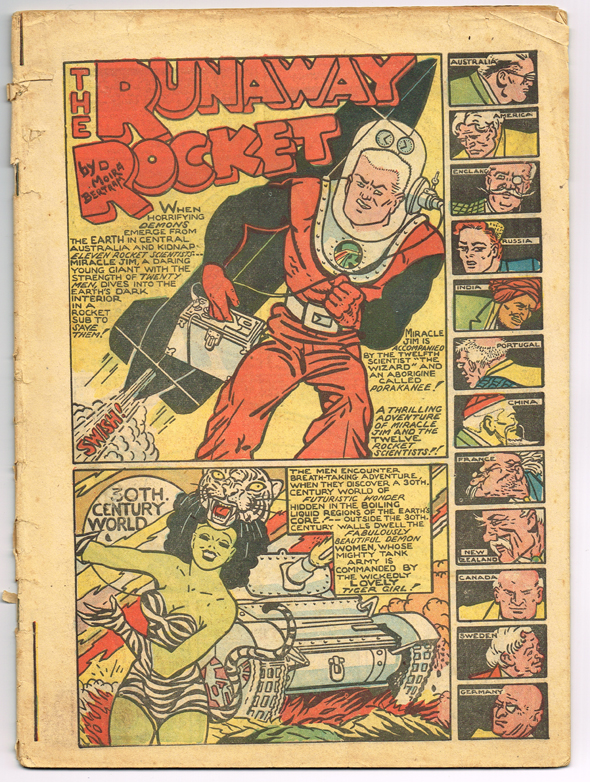
Her parents didn't object, although her mother might have preferred Moira to stick to portrait-painting. Her father was a Sydney wool shipper, with offices on Broadway, New York; Moira and her sister visited New York and Hong Kong, but her most exotic travels are in the comic books, which display a remarkable variety of settings and hardware — such as flying-boats doing vertical nose dives, army planes and cross-sections of landing craft (Vehicle Personnel type). This last item appeared in a comic called Mission: Front Line! It was a most professional piece of work, with plenty of men in army uniforms and gear fleeing from very convincing explosions. "Oh yes, I did quite a lot of war comics," Moira said. "I just asked the publisher if he'd like some, he said yes, and so I did them." Mission: Front Line! (and others like it) appeared to have been done during the Korean War. Some of her comics wound up on a mess table in Vietnam — she had a letter from a soldier saying so.
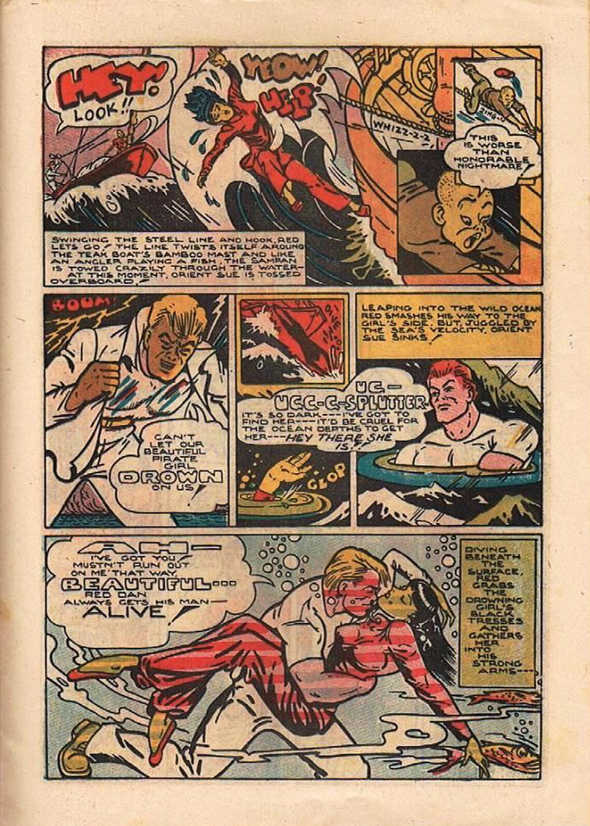
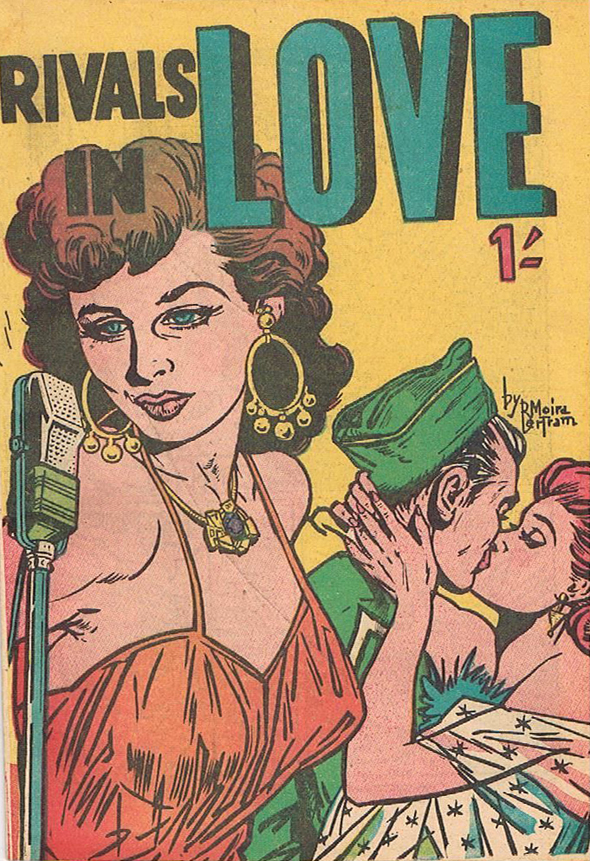
"I never have much trouble," she said. "I don't like to flatter myself but I can draw anything." She seemed equally happy drawing rockets, tanks, spacecraft, burly men, bosomy women, shipwrecks, horses, dragons, nightclubs, planets; however, even in The Love of Dr Ames, a conventional love comic with the prelude "In spite of our quarrel, I knew I still loved Gary. That night I could not sleep " her style declared itself (about halfway through the book) with a frame of a car smash: a telegraph pole up very close in the foreground, a car's bonnet wrapped around it, and in the distance a policeman's head inspecting the wreckage.
(Not many people know of Moira Bertram's work, though she produced hundreds of comic books in the forties and early fifties. John Ryan's book Panel by Panel — an illustrated history of Australian comics — mentions her briefly, but gives no biographical details. Roger Morrison, a comics connoisseur who runs the Nostalgia Book Exchange and Old Comic Shop, said: "Yes, Moira Bertram is probably the only female comic book artist in Australia. The panels in her books were very striking — the proportions were different to everyone else's. She used a lot of frames where you look down into the distance, with big shapes in the foreground, 20 years before that style developed in the 1960s, among American artists.")

"Oh, I did get a letter from John Ryan when he was writing the book," said Moira, "asking for information, but I just put it to one side and I don't think I ever answered it. I never bothered much. I get letters all the time from people in America, lots of collectors. I had a letter from overseas recently, telling me they're putting me in another book."
Just then a huge household cat mooched in like a black-and-white tank; his name was Hong Kong, Moira said: "He eats me out of home and house." She and her sister went to Hong Kong once. They did a lot of silk designs for Japanese Companies, and perhaps this trip influenced one of their most striking comic-book productions, the Red Finnegan series, which they published themselves. Red Finnegan is a man of such action that his tie is often drawn whipping across his chest at right angles even when he is standing still. The drawing in this black-and-white detective epic is much more stylised than (for instance) Flame-man. Set in Japan, the Red Finnegan adventures have an Oriental look; striking patterns and black silhouettes are used, lines are clean and elegant. The heyday of Australian comics came to an end in the late fifties. High-quality American imports. censorship and television were factors in their demise. Moira Bertram's work clearly belongs to this golden age. Ryan, in an issue of his newsletter Down Under (a comic "fanzine") said, "To me, her stories appeared to combine flashes of Milton Caniff and Al Capp — with a touch of Hans Christian Anderson thrown in."
Often people, especially women, whose main work was done in an earlier period, take for granted that it has become outdated and can hardly believe in its worth any more. Moira Bertram, a few years ago, threw much of her original work away. "I just thought I ought to get rid of it, really. I filled up two cardboard cartons with drawings and gave them to the paper collector. I suppose it was silly of me, but I never thought anyone would be interested in those drawings. You know, they were floating up and down the street for days." She laughed.
Further samples of Moira Bertram's comics,
Romance and Action Splash pages
Article reprinted with kind permission of Sally McInerney and sourced from the Rare Books Library at Monash, Melbourne.
