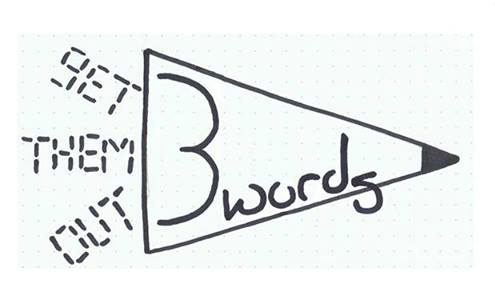
Three Words is a forthcoming New Zealand comics anthology spearheaded by three editors, Sarah Laing, Rae Fenton and Indira Neville. Focusing on New Zealand's female cartoonists, submissions are currently being accepted until Oct 31st.
From the 3 Words Blog,
"The book will incorporate both existing and new work. We want to make visible the depth and breadth of New Zealand women’s comics; showing off some of the beautiful, amazing and often-unseen women’s comics of the past, as well as providing an opportunity for collaboration and the creation of new book-specific pieces via the Three words concept. Interested? Three words wants you."
More details on Three Words Facebook and Blog.
In my professional capacity as a mailman I asked a few questions of the Three Words Editors.
Matt Emery: How did you ladies come to collaborate on this project?
Sarah Laing: I knew Indira and Rae through Facebook and, in Rae’s case, comics dos, and I met Indira at this year’s zine fest. When I suggested we get together an anthology of women’s comics Indira was immediately keen - the time was ripe, and she’d compiled women’s comics in the past. We invited Rae too because we knew she was smart, an experienced editor, and an awesome writer of comics, fiction and poetry. Besides, we’d all been quite active in an online debate post publication of Adrian Kinnaird’s From Earth’s End - which was fantastic but notably short on women’s comics. We all come from slightly different points on the comics spectrum and thought that our perspectives would make for a diverse, challenging book.
Indira Neville: Another good reason for including Rae is that she is a total rabble-rouser!
Rae Fenton: I'm not so much a rabble-rouser as fiercely working-class. When From Earth's End was published, it was immediately apparent that it would be a terrific resource for "Competent boy comics" (see Indira's Q1), and their fans, but bugger all use to those of us in the comics scene who didn't already have an established network, platform or voice. Historically, men look after their own and women are written out of history in exactly the way From Earth's End unintentionally demonstrates, more so working-class and minority women. Both Indira and I were very vocal at the time of From Earth's End's publication that this needed redress. I had already made enquiries with a view to funding a women's anthology, so when Indira and Sarah contacted me to say they were putting together an anthology and asked if I'd like to hop on board I said yes.
Indira Neville: See? :)
Rae Fenton
Matt Emery: Why do all recent NZ comics publishing entities involve three people?
Sarah Laing: Are you talking about From Earth’s End? I suppose 3 is the magic number (now I’ve got De La Soul in my head). The holy trinity, the tryptic, the sides of a triangle. 3’s a prime number. Because comics publishing is hardly a money making exercise it’s good to have a few people to share the work. We’ve been delegating responsibilities - I lead the CNZ grant application, Rae’s managing the social media and Indira has been luring some fantastic contributors. We’ll continue sharing the load to make sure it doesn’t feel too hard - all of us have incredibly busy lives, working, looking after kids, making comics.
Indira Neville: Plus, if there are disagreements, with three you can always resort to a tie-breaking vote. This is very useful and efficient.
Matt Emery: I like that the Three Words project is looking at including older works and female cartoonists that may not have been particularly prolific in recent years, what inspired this?
Sarah Laing: I wanted some community around me - I knew it was there - but because of the ephemeral nature of comics publishing it was hard to find. Whenever I went to comics drinks there’d only be a couple of women there in a sea of men. I missed the 90s comics scene - I was busy being a graphic designer, music fangirl and performance poet - and I wanted to make up for my ignorance. It’s a process of self-education for me. I really want to catch all the amazing comics that slipped by me - to put them in a book that can be sold in bookshops and borrowed from the library, or seen on our blog. I want permanence in a world of crumbling photocopies in boxes under beds.
Indira Neville: Sarah, your response is so interesting! I fully agree with the ‘saving crumbling photocopies’ idea (have you been snooping under my bed?!) and the desire for community, but I’m struggling to relate to your comments about not being part of the 90s comics scene because you were doing other things. My experience is different, for me comics were part of a larger friends and ‘making stuff’ scenario, which also involved plenty of band fangirl action (and general heckling of performance poets – although I’d love to see you and I promise I would be very well behaved) and making music and other stuff. And it’s still that way actually, I went to a Clean Yr Teeth tape launch the other night and all the tape cover were comics (actually all tape covers are comics by default – they are Illustrations and words in panels). Not sure really what I’m talking about, I guess it relates back to that idea of the three of us having different experiences and perspectives and that this makes for a heady editorial brew!
Rae Fenton: As someone whose first paid job was in graphics, painting feminist cartoon inspired murals, aged seventeen, but who then spent the 90s busily trying to work my way out of poverty in Northern England, I had had a long period of not appearing prolific -- a hole in my comics CV that gave rise to the well meaning if wholly patronising comment "keep progressing with your work, it's really coming along well" from one of my male peers -- I understand the difficulties inherent with maintaining creative output for some women. Certainly for working-class women. The notion that a woman is less deserving of a place in a comics history or anthology based solely on the volume of her work is simply a middle-classed patriarchal view. I don't think I'm speaking out of turn to say that Indira and Sarah and I would all like to change this view.
Indira Neville: Yep, I think if you only ever make one comic it's still valid as a piece of work. Hey Rae, do you have any photos of your murals? they sound amazing.
Sarah Laing
Matt Emery: New Zealand is a very multicultural society, although by and large I think the comics community there is populated by white male folk™, are you getting submissions from contributors with a variety of backgrounds and cultures? I'm not suggesting a person's background/culture needs to necessarily reflect the art they make but I do enjoy reading comics about NZ experiences from other than white male folk™ (as well as) and perhaps these are stories that aren't explored very often in NZ comics?
Sarah Laing: Yes! Although of course we’d love more. We have contributions from women of Maori, Asian, Indian and European heritage, and we’ll be including lots of queer comics, and some by women with disabilities. We're open to comics by transgender people who identify as women, or who once identified as women. I love reading comics in general, but I particularly love reading comics by women from all over the world and their non white male folk™ perspective. I’ve been trying to figure out why the NZ comics scene is dominated by white men when other branches of art and literature have a larger female contingent - I think the poetry scene was the same in the 80s. I loved reading comics as a kid but when I grew older I was too scared to go into comics shops as they seemed to be the domain of the dungeons and dragons boys. I satisfied myself by reading the cartoons in in my women’s studies text books. Discovering Julie Doucet in 2000 was a bit of a reawakening for me, and made me want to draw comics again. I am hoping that our anthology will act as an inspiration for younger women comics creators, and they will see that women are making amazing comics here.
Indira Neville: Not sure about the ethnicity / background thing, but we definitely have women who have all kinds of perspectives, and lives, and that make all kinds of comics. I like that we have contributors from the literary comics scene, the craft comics scene, the zine comics scene, the commercial comics scene, the art comics scene, and the political comics scene. And having just categorised all these different kinds of comics I’m going to completely undermine myself and say that one of the things I’m really looking forward to is just having all these comics side-by-side in a book. No categories or qualifiers or comments or ratings or judgements – just comics! Any written discourse about the works will be provided by the contributor, no ‘experts’ involved.
Indira Neville
Matt Emery: Who are some of your favourite female cartoonists? What are the particular themes/genres or aesthetics that appeal to you about their work?
Rae Fenton: Thank goodness you didn't ask me my favourite colour! Hmn...In terms of New Zealand female cartoonists: I know Sarah Laing, Indira Neville, Ralphi (Lauren Marriott), Jem Yoshioka, Robyn E. Kenealy, um...you see, before Sarah and Indira and I started this anthology, there were, it seemed, no other female cartoonists in NZ. Coming from overseas it was obvious that, unless you were part of the established scene and had personally been introduced to a cartoonist/comic artist and or their work, there wasn't a simple or straightforward way of finding out who the other female cartoonists were - which is precisely why Three Words is such an important project. Outside NZ, I'm a big fan of Andrea Offermann - I first saw her work in the Flight anthology, maybe issue 4, with a piece called "Twenty-four Hours", and thought it was amazing, just a perfect balance of detail and ambiguity - I guess poetry is my favourite genre. Aesthetically, anything that's messy around the edges; nothing too neat or polished. Graphic novel wise, there's Marjane Satrapi's Persepolis and its successor, and Alison Bechdel's Fun Home - I cannot read the ending, where young Alison's dad catches her in the pool, without crying - every time, possibly because my dad was such a shit to me; I guess I feel an affinity for the characters and their tenacity. I'm very drawn to works that explore feminist politics and class and represent the sort of women that I can identify with: women society has tried to keep quiet.
Indira Neville: Weirdly no one ever asks me this question (so thanks Matt). Probably it won't make great copy but I'm going to take advantage of the opportunity to list a few non NZ women comic artists I love: Tove Jansson (sigh), Reina Bull (with her science fiction pot boiler connections and complete disregard for anatomy), Marjorie Owens (she drew these lovely whimsical British nursery comics), Chiyomi Hashiguchi and Hanako Yamada (always such a welcome relief from all the peckers in Garo, but also some of the weirdest comics in there). Juliana Buch Trabal (she is one of the few identifiable individuals I have been able to discover that was part of the girl comics scene of the 70s and 80s (Judy, Bunty, Tammy, Mandy etc) and with which I am a bit obsessed). For a million years Dame Darcy was my favourite comic artist and then I unfortunately heard her band and thought it was a bit lame and then saw an interview with her and didn't much like her, but when I remember to forget these things Meatcake is still amazing.

Matt Emery: Is there much happening in the way of editorial input or curating with Three Words?
Rae Fenton: Definitely, there have been many discussions around the aesthetics of Three Words, and its proposed contents. Each of us, Indira, Sarah and I, have our own preferences in terms of what sort of work appeals to our personal tastes, and each of us champions a differing ethos, so I envisage a lot of healthy debate about which submissions get in and how they will be ordered.
Indira Neville: There is also the Three Words framework we have set up for the creating of new work. We thought it was important to have some stuff that no one has ever seen before, and also an opportunity for artists to collaborate with each other. One nice thing that has happened as a result of this idea is that some women who are keen to be in the book, but who haven't made comics for a significant period of time, have expressed excitement about making something new.
Sarah Laing
Matt Emery: What has been challenging about assembling this project so far?
Rae Fenton: The greatest challenge for me has been the lack of a one-stop shop for contacts, as I mentioned earlier, but this just tells me how needed Three Words is; this will be, to the best of my knowledge, the first anthology of its kind for women comics artist and cartoonists in New Zealand, and will, I hope, also function as a beginners' directory, if not a definitive one. I'd like to see New Zealand's women cartoonists, comic artists and graphic novelists in books like Graphic Women, by Hilary L. Chute, for example. But a lot of NZ comics artists seem happy to remain underground, which is fine, but I think history has shown us how underground can be a synonym for buried. Accounting for everyone may prove our greatest challenge overall.
Matt Emery: Indira, there was a wonderful phrase you used in a facebook comment to describe what you disliked about a portion of the NZ comics community/scene that I can't for the life of me find or recall specifically but I thought it a very astute observation at the time. Do know what I'm talking about? Can you elaborate on my vagueness?
Indira Neville: Heh. I can’t recall the exact words but it would have been one of my standard rants about the idea of ‘competent boy comics’. ‘Competent boy comics’ is a term I use to describe the current high profile and related proliferation of a certain kind of comic in New Zealand. In my opinion, these comics share a number of characteristics - a very proficient drawing style, a tasteful colour palette, a commitment to traditional linear narratives, page layouts and frames, and an adherence to the conventions of whatever genre the artist is working in (usually adventure/action and/or fantasy and/or slice-of-life/biographical). They essentially have a kind of ‘professional’ inoffensive smoothness and adequate appeal. It’s also important to note that ‘competent boy comics’ aren’t only made by boys, in this context I think of ‘boy’ as an adjective rather than a noun.
I have a couple of thoughts about ‘competent boy comics’ – the first is that they are just not my cup of tea. Some examples are blander than others, but I actually really struggle to see any of these comics properly, they all look pretty much the same to me and my eyes just slide off the page. They seem to me to eliminate all the things that make the medium of comics amazing – the weirdness, the silliness, the mess, the horror, the confusion, the spazziness, the raw, the personal, the grubbiness, the joy and the home-made.
I accept however, that what I have just described is simply a matter of taste, and that these kinds of comics can still be valid even if I don’t personally like them. My second point however is that, while the works themselves may be valid, the discourse around them isn’t (to be fair this doesn't necessarily come from the artists) and it really pisses me off! Essentially it seems to me that many people do not recognise ‘competent boy comics’ as just one way of approaching the medium. Instead these works are represented via the obliviously offensive notion of a comics ‘maturity’ or ‘pinnacle’, as if they are ‘better’ and something for other kinds of comic artists to aspire to – yuck!
This idea was acutely illustrated for me when one prominent New Zealand comics personality publicly compared the ‘progress’ of New Zealand comics with that of the Dunedin music scene. As I remember it, he essentially talked about how making comics was kind of an underground DIY activity like music in the early years of Flying Nun, but that now, like Flying Nun, comics are widespread and professional and accessible and commercially viable. For me this analogy has two main flaws – firstly the DIY music scene didn’t stop just because Flying Nun became a ‘proper’ record label; and secondly, when Flying Nun did go all respectable we had to listen to a lot of really shit bands (remember Garageland and Superette!?)
Rae Fenton
Matt Emery: Announcements of Three Words contributors have been slowly trickling out on FB, has there been some pleasant surprises amongst the artists you've lined up to be involved?
Indira Neville: Yes! And for two kinds of reasons – there are artists whose work I just love and want to see in a fancy book (like Ducklingmonster, Jessica Dewes, Elizabeth Mathews, Susan Te Kahurangi King); and there are artists whose contribution to the NZ comics scene is important (like Renee Jones, Robyn Kenealy, Sharon Murdoch, Lisa Noble, Rosemary McLeod, Coco Solid) Oh and I like their work too!
Also I am very excited about a couple of essays we have planned for inclusion; one is about the unsung comic heroines of Broadsheet and the 80s lesbian scene - Wonderful weird comics, almost never seen outside of their niche. The other is going to be about Debra Boyask, written by her sister Ruth. Debra was a kick-arse comic artist, but also an incredible connector and encourager of others. I am so happy we can acknowledge her important work.
Sarah Laing
Matt Emery: Many of the new NZ female cartoonists I've discovered in recent years work almost exclusively in the digital realm. Are any lady-drawers fitting this description involved with Three Words?
Indira Neville: I’m sorry, I really don’t know the answer to this question. None of the women contributors I know are digital-exclusive, but there are women submitting that I know next-to-nothing about, so maybe? Also my experience is not the same as yours. My recent ‘discoveries’ use paper, like Jessica Dewes, Phoebe Carse, Charlotte Hague, and Katie Parrish.
Actually, most women artists I know aren’t even exclusively comics! For example, Sarah and Rae also write; Stella Corkery, Rachel Shearer, and Alie MacPherson are fine artists; and me, Duckling Monster, Coco Solid and Liz Mathews also make music.
Rae Fenton: I'm going to draw a comic about all the synonyms men feel compelled to use when talking about women cartoonists: "lady-drawers" is going in there. Definition: feminine knickers with pencil holder.
Indira Neville: Hey Rae - let's you, me and Sarah start a band called Lady-drawers!
Sarah Laing: You're on.

Indira Neville